


The Return-to-Office Wave Has a Hidden Casualty: Your Employees' Pets

And What HR Leaders in Pittsburgh Can Do About It

The return-to-office push is officially in full swing. Here in Pittsburgh, PNC Bank recently called its remote workforce back to five days a week in the office — and across every industry, major employers from Microsoft and Novo Nordisk to Amazon and JPMorgan Chase have tightened or eliminated remote and hybrid arrangements in 2025 and 2026.The reasons are familiar: collaboration, culture, visibility, accountability.
But buried inside every RTO policy is a workforce problem most HR managers haven't yet put on their radar: what happens to the pets your employees spent the pandemic raising?
This isn't a soft, feel-good issue. The data says it's a retention, productivity, and recruitment problem — and Pittsburgh employers who recognize that early will have a meaningful competitive advantage.

The Numbers HR Leaders Should Know
The pandemic pet boom was real and lasting. An estimated 23 million U.S. households acquired new pets between 2020 and 2023 — animals raised alongside owners who were home full-time, every day, for years. Today, 95 million U.S. households own a pet. That means the majority of your workforce is a pet owner.
What's changed in 2026 is the collision between two trends:
Stricter in-office requirements — 77% of new job postings in Q1 2026 are fully on-site, a significant reversal from the flexibility peak of 2022–2023.
Pet-dependent employees who built their lives around remote work — half of pet owners who adopted during 2020–2022 say remote work made getting that pet possible in the first place.
When those two realities meet, the friction shows up in your workforce data.
What RTO Is Doing to Pets — and to Employee Focus

Dogs and cats raised during the work-from-home era were never conditioned to be alone. As RTO policies expand, the behavioral consequences are measurable. Research shows 42% of pet owners have observed behavioral changes in their animals — most commonly increased clinginess (23%) and separation anxiety (22%). Among employees who experienced reduced workplace flexibility, that number jumps to 80% reporting at least one behavioral change in their pet.
What does that mean for the employee sitting at their desk in your office? Distraction, guilt, and stress — the exact conditions that erode the productivity RTO policies were designed to improve.
There's also a harder number worth noting: 21% of pet owners say they would consider leaving their job if required to return to the office full-time, in part because of their pet. In a tight labor market, that's not a small population.
Why This Is an HR Problem, Not Just a Pet Problem
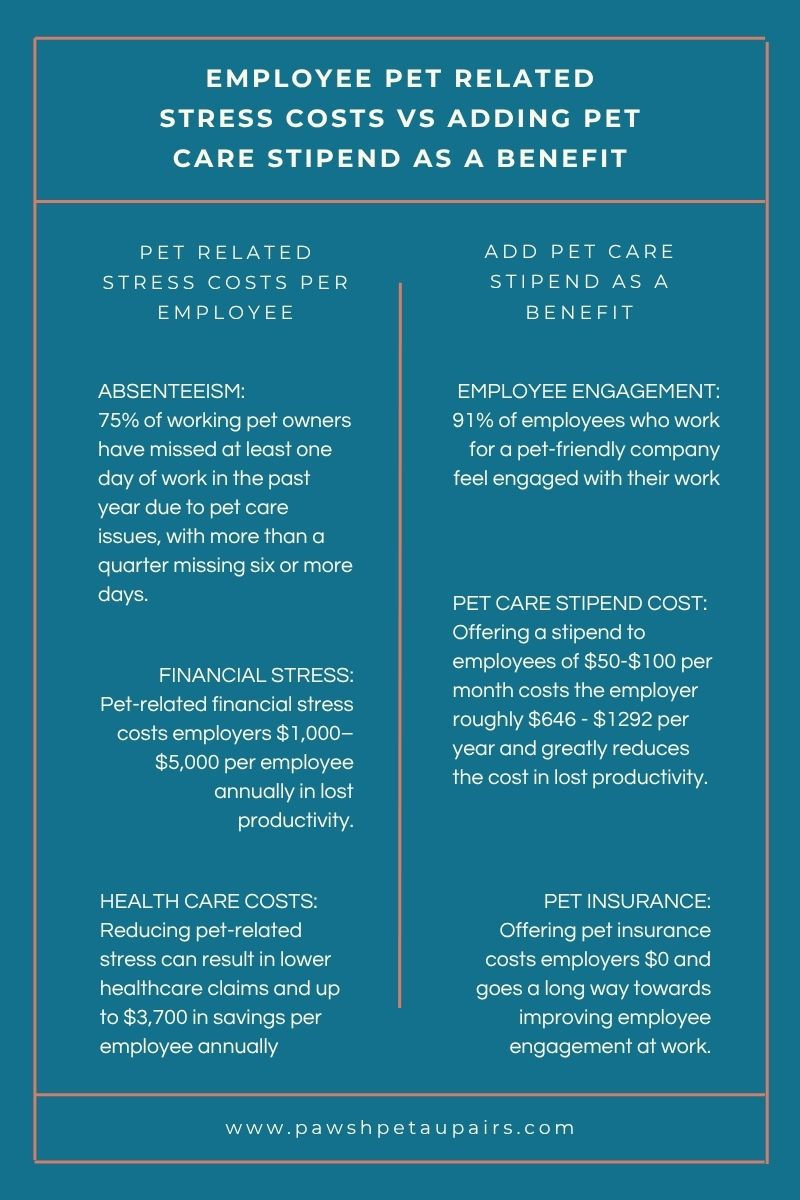
Forward-thinking HR leaders have already connected the dots. A 2025 survey by Airvet found that pet-related financial stress costs employers $1,000–$5,000 per employee annually in lost productivity — driven by a combination of absenteeism, presenteeism, and financial anxiety that follows pet owners into the office. Reducing that stress through targeted benefits translates to real, measurable savings.
The cost of doing so is more accessible than most HR leaders assume. The most common approach is a monthly pet care stipend — typically $50–$100 per employee — which workers can apply to any pet-related expense, from veterinary bills to professional dog walking. At $100 per month, the true employer cost (including the FICA tax obligation on taxable fringe benefits) runs approximately $1,292 per participating employee annually. For employers not ready for a cash stipend, pet insurance offered as a voluntary group benefit can be added at little to no direct employer cost — employees pay the premium themselves but gain access to group rates they couldn't otherwise obtain.
The retention math makes either option easy to justify. Research indicates 63% of pet owners are more likely to remain with an employer that offers pet-related benefits. Turnover, by contrast, costs organizations anywhere from $4,000 to $21,000 per employee — meaning a single retained employee more than covers the annual cost of the stipend program many times over. Airvet's data also points to a healthcare cost dimension: reducing pet-related stress can result in up to $3,700 in savings per employee annually through lower healthcare claims, a figure that doesn't show up in productivity metrics but lands directly on the benefits budget.
The employer landscape is responding. According to Gallagher's 2025 Benefits Benchmarks Report, the share of employers offering pet insurance has grown to 33%, up from 23% in 2023. Millennials and Gen Z — now the dominant workforce cohorts — rank pet benefits among their top desired offerings. As one Gallagher benefits leader put it, employers who adapt to meet this segment "attract and retain" more effectively than those who don't.
What a Pet-Supportive HR Strategy Actually Looks Like

Supporting pet-owning employees doesn't require overhauling your benefits package overnight. Here are practical, scalable approaches:
1. Offer or subsidize professional pet care during office hours. Midday dog walks and in-home drop-in visits are among the most effective ways to reduce separation anxiety and keep employees focused during the workday. A partnership with a trusted local provider — like Pawsh Pet auPairs, which serves Pittsburgh neighborhoods including Shadyside, Squirrel Hill, Lawrenceville, and beyond — gives employees a vetted, reliable resource without the burden of finding one themselves.
2. Create a pet care stipend or voluntary benefit. Similar to commuter benefits or wellness stipends, a modest monthly pet care allowance signals that your organization sees employees as whole people with real responsibilities outside the office. Even a small subsidy toward professional dog walking or pet sitting can make a meaningful difference in daily stress levels.
3. Build it into your RTO communication strategy. If you're announcing new or expanded in-office expectations, pair that communication with resources for pet owners. Employees who feel their concerns were anticipated — rather than overlooked — are far more likely to comply with policies and remain engaged.
4. Normalize pet care as a workplace wellbeing conversation. You don't need pets in the office to build a pet-inclusive culture. Acknowledging "pet parenthood" as part of work-life balance — in wellness programs, benefits communications, or manager training — reinforces that the organization values the whole employee.
The Pittsburgh Opportunity

Pittsburgh is a city where pets are family. As more local employers call workers back to the office — and as more employees navigate what that means for the animals they raised during three-plus years of remote work — HR leaders who move proactively will earn loyalty that mandates alone cannot buy.
The conversation about RTO is happening in every Pittsburgh boardroom. The conversation about what employees need to make it work is still catching up. Pet care is one of the most tangible, low-cost, high-impact ways to close that gap.
Pawsh Pet auPairs partners with Pittsburgh-area HR teams to provide reliable, in-home pet care for employees — midday dog walks, drop-in visits, cat care, and more. Every visit is one-on-one: we never walk multiple households together. Ready to explore what a partnership could look like for your team?
👉 Contact us to learn more | (412) 356-9921
Sources
Founder Reports. Return-to-Office Statistics and Trends (2026). April 2026. https://founderreports.com/return-to-office-statistics/
Robert Half. Remote Work Statistics and Trends for 2026. April 2026. https://www.roberthalf.com/us/en/insights/research/remote-work-statistics-and-trends
Shelter Animals Count. How the Pandemic Affected Separation Anxiety in Dogs and Humans. 2024. https://www.shelteranimalscount.org/how-the-pandemic-affected-separation-anxiety-in-dogs-and-humans/
American Pet Products Association (APPA). Pet Industry Market Size, Trends & Statistics. 2026. https://americanpetproducts.org/industry-trends-and-stats
Pet Emergency & Specialty Center of Marin. The Return-to-Office Shift Is Reshaping Pet Care. May 2026. https://pescm.com/san-rafael-ca/blog/remote-work-pet-effect/
Airvet. 2025 Survey: The Impact of Pet Benefits on Your Workforce. 2025. https://www.airvet.com/blog/2025-survey-the-impact-of-pet-benefits-on-your-workforce
BSI Corporate Benefits. Fetch This Perk: Why Pet Benefits Are One of the Hottest Trends in HR. May 2025. https://bsicorporate.com/fetch-this-perk-why-pet-benefits-are-one-of-the-hottest-trends-in-hr/
Employee Benefit News / Shutan, Bruce. Pet Benefits Expansion Reflects Changing Culture. November 2025. https://www.benefitnews.com/advisers/news/pet-benefits-expansion-reflects-changing-culture
Gallagher. 2025 U.S. Workforce Trends Report: Benefits Benchmarks. 2025. https://www.ajg.com/2025-us-workforce-trends-report-benefits-benchmarks/


Comments